
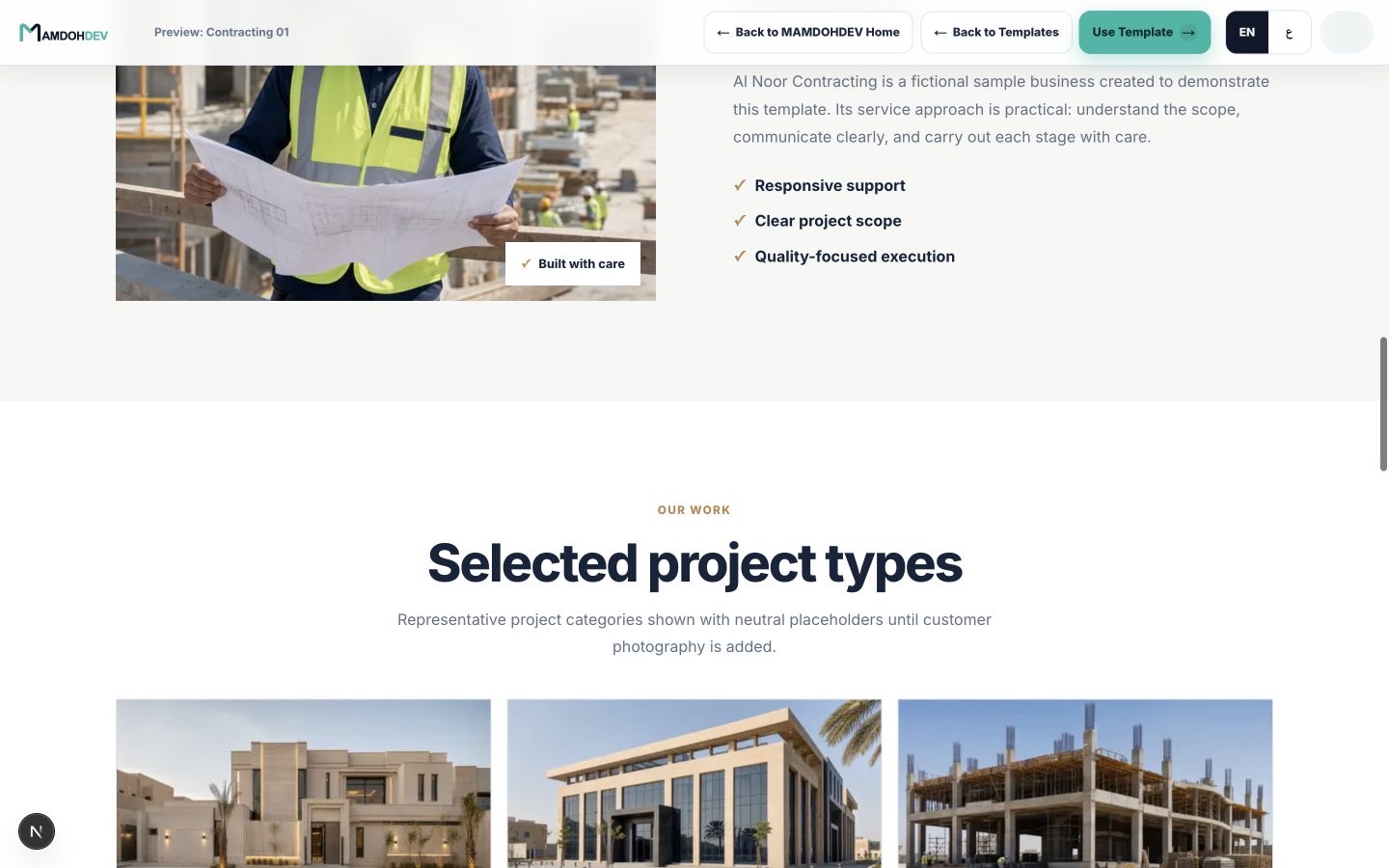
The essential pages for a contracting company website
A professional contracting company website does not need dozens of pages. It needs a clear path from first impression to evidence and contact. Keep every page focused on a question the customer is likely to ask.
| Page or section | What the customer should find |
|---|---|
| Home | Main service, service area, proof, and one clear next step |
| Services | Separate, practical descriptions of the work you actually provide |
| Projects | Relevant examples with scope, location, and your role |
| About | Who the company serves, how it works, and verifiable credentials |
| Request a quote | A short form that collects enough information to respond |
| Contact | Phone, WhatsApp, email, location, and working hours where relevant |
If you want to see how that journey can be presented before writing your own content, review how MAMDOHDEV works.
Next useful guides: How much does a business website cost in Saudi Arabia?, Website vs social media: what does a small business need?.
Explain services and service areas precisely
Avoid a single vague label such as “general contracting” if your team actually focuses on villa construction, fit-outs, renovation, maintenance, or site preparation. A short page or section for each core service helps customers self-select before they contact you.
- Describe the project types accepted and the work included.
- State the cities or regions served without implying nationwide coverage.
- Use the same service names in navigation, headings, and quote forms.
- Explain exclusions or specialist boundaries when they matter.
Turn past projects into useful case studies
A gallery proves that work exists; a short case study explains why it is relevant. Use genuine photos you have permission to publish, then add enough context for a prospect to understand the scale and type of work.
What to include with each project
- Project type and general location, without exposing a private address.
- Scope of work and the part your company delivered.
- A practical constraint, such as an occupied site or delivery schedule.
- The completed outcome, stated factually rather than as an unsupported claim.
Use trust signals customers can verify
Trust comes from consistency and evidence, not a row of impressive-looking badges. Show the company name and contact details consistently. Include licences, classifications, memberships, warranties, or safety practices only when they are current, accurate, and relevant to the work.
- Real project photographs and clear captions
- Current business details and service locations
- Named services with realistic scope
- A clear privacy notice for quote forms
- Testimonials only with the customer’s permission
Make quote requests easy on mobile
Many prospects will first view the site on a phone, sometimes while standing at a project location. Use readable text, large tap targets, a direct call or WhatsApp option, and a short quote form. Ask only for details your team needs to make the next conversation useful.
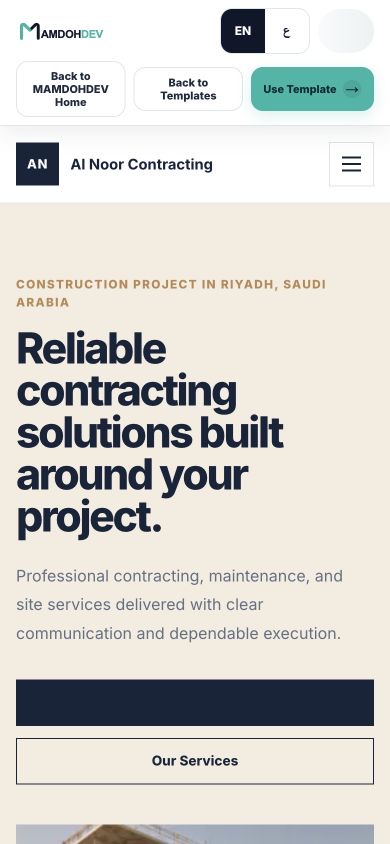
Useful quote-form fields
- Name and preferred contact method
- Project type
- General location
- Approximate timing
- A short description of the requested work
Plan bilingual content and local visibility
For a Saudi contracting business serving Arabic- and English-speaking customers, each language should read naturally and lead to the same services and contact options. Do not publish an incomplete second language just to display a language switcher.
Use descriptive page headings, consistent business details, and honest service-area wording. You can compare the bilingual behavior in the public contracting template before choosing a structure.
Start with a focused website, then improve it
A focused launch can include services, selected projects, an about section, and contact details. Before committing to a scope, understand what affects website cost in Saudi Arabia and decide how the website will work alongside your social media accounts.
After launch, review the questions customers ask most often. Those questions can guide the next service page, project case study, or form improvement instead of adding pages without a business reason.
Frequently asked questions
What pages should a small contracting company website have?
Start with a home page, services, selected projects, a short about section, a quote request, and complete contact details. Add separate pages only when they answer a customer need.
Should every project be published on the website?
No. Select projects that represent the services you want to sell, and publish only photographs and details you have permission to share.
Does a contracting website need Arabic and English?
It depends on the customers and partners you serve. If both languages are needed, translate the full customer journey—not only the navigation—and keep service and contact information consistent.