
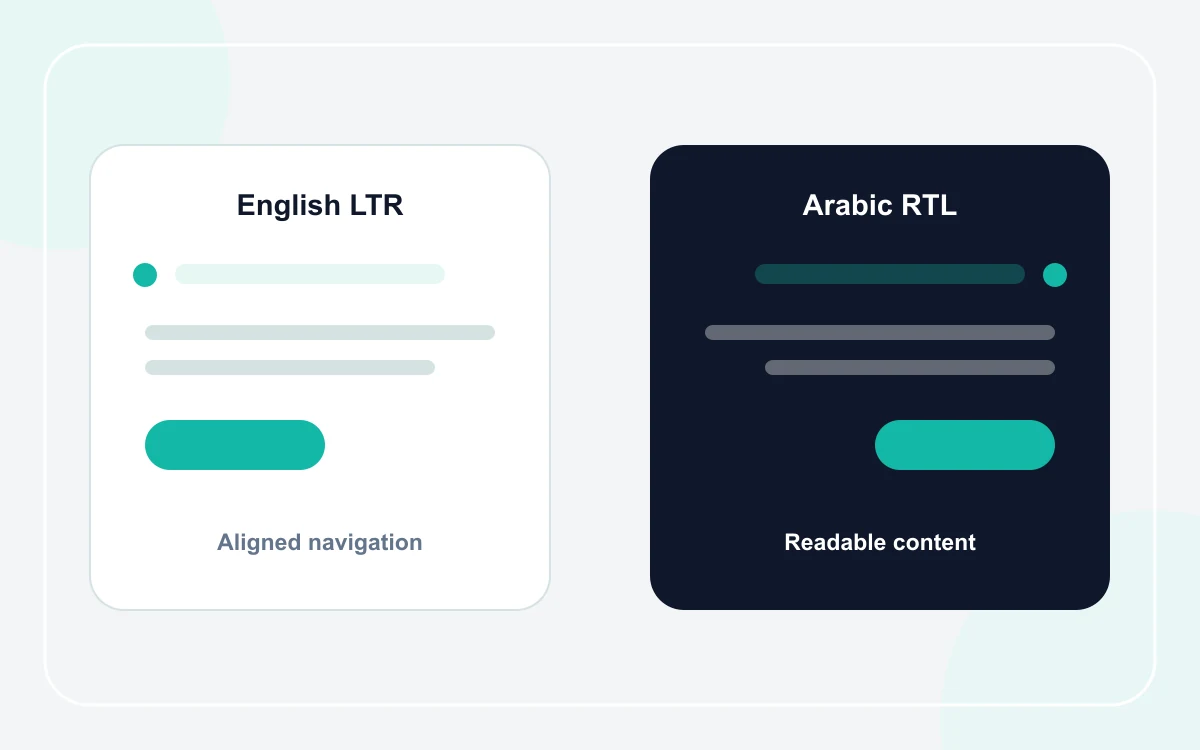
Start with real RTL support
Right-to-left support affects more than text alignment. Navigation order, arrows, icon placement, form labels, tables, breadcrumbs, and mixed Arabic-English content all need to remain understandable without visual collisions.
- Set the document language and direction correctly.
- Test long Arabic headings instead of only short placeholders.
- Check phone numbers, prices, and mixed Latin terms for readable ordering.
- Verify cards, tables, and buttons on narrow screens.
Next useful guides: How to create a business website step by step, What pages does a small business website need?.
Write natural Arabic for the customer
Literal translation often produces long or formal wording that does not match how customers ask for a service. Write the Arabic version around the same business meaning, then choose familiar terms for the market and service category.
Keep calls to action direct. Phrases such as طلب عرض سعر، تواصل معنا، شاهد الخدمات، or احجز استشارة are usually clearer than abstract marketing language when they match the actual next step.
Keep Arabic and English versions consistent
If the business needs two languages, both should contain the important services, contact options, policies, and customer steps. A language switch should not send the visitor to a different or incomplete journey.
| Element | Check |
|---|---|
| Services | Same real service scope in both languages |
| Contact | Same current phone, email, and working information |
| Calls to action | Same intended customer action |
| Policies | No missing important terms in one language |
| Navigation | Equivalent destinations, not merely translated labels |
Make Arabic pages useful on search and mobile
Use page titles and headings that describe the service in words customers understand. Avoid stuffing several variations of the same keyword into every paragraph. Clear service names, locations when relevant, and complete answers are more useful than repetitive phrasing.
If you want a broader starting process, use the step-by-step business website guide. You can also preview MAMDOHDEV templates in the supported language direction before choosing one.
Frequently asked questions
Is translating an English website enough for Arabic customers?
Not by itself. The Arabic version should also support RTL correctly, use natural wording, preserve the same customer journey, and remain readable on mobile and in forms.
Should Arabic and English pages have exactly the same wording?
They should communicate the same business facts and actions, but the wording can be adapted so each language sounds natural and clear to its audience.